The State of Human Evidence 2027
When AI can produce the work, what proof should you trust?
We asked 148 U.S. hiring managers. Explore the early findings: five headline results, three moves for hiring leaders, and the study’s method and limits.
Three-page briefing available now with your work email. Full report releases early January 2027.
A public research initiative founded and funded by SignalVerified (opens in a new tab).
Early findings · available now
41% say 1 in 4 hires or more fell short
When AI can produce the work, what proof should you trust? We asked 148 U.S. hiring managers and executives. The early findings briefing is available now for hiring leaders: five headline results, three moves they point to, and the study's method and limits. The full report follows in early January 2027.
- 88% were involved in a hire that turned out weaker than the evidence suggested.
- Only 12% accept the output alone as proof when AI may have helped.
- 57% want a finalist work task for most roles. Only 6% run one.
Share your name, work email and organization to download the three-page briefing immediately.
The central question
When a machine can produce the artifact, what is the evidence that a person contributed the capability, and who decides that it counts?
Most work on artificial intelligence measures what the systems can do. Far less is known about the people and institutions on the other side of that output: the employers, educators and decision-makers who must still judge capability, and who are working without an evidence base for how to do it.
What we study
Four lines of inquiry
- 01
Capability under automation
Which human abilities become more valuable, not less, as systems absorb routine analysis, drafting and production work.
- 02
Evidence organizations trust
What employers, educators and institutions currently accept as proof of a person's contribution, and how well that evidence holds up.
- 03
Attribution of work
How contribution is judged when a piece of work passes through people and machines together, and where credit is misassigned.
- 04
Decisions that follow
How hiring and promotion decisions change once the origin of work becomes uncertain.
The study
The State of Human Evidence 2027
The first wave of an annual research initiative, built around one core question: what evidence do organizations trust when evaluating human capability in AI-enabled work? Wave one is for US managers at organizations with 50 or more employees who made or influenced a hiring or promotion decision for a knowledge-work role in the past 12 months.
Fieldwork for the main study closed in October 2026. A public summary of the findings releases in early January 2027, with the full report, dataset and methodology available to research partners.
- Field
- Human capability and evidence of contribution
- Population
- US managers who made or influenced a hiring or promotion decision for a knowledge-work role in the past 12 months, at organizations with 50 or more employees
- Instrument
- Structured survey with judgment tasks
- Collection
- Completed October 2026, single wave. 148 qualified U.S. hiring managers after quality review.
- Outputs
- Public findings summary; full report, dataset and methodology for research partners
Transparency
Research, then conclusions
The Human Evidence Project is a public research initiative, not an institution. It is founded and funded by SignalVerified (opens in a new tab), a company with a commercial interest in this subject. We disclose that in the open rather than in a footnote, and the principle that governs the work is simple: research first, company second.
The full research record
The survey, methodology and analysis plan are documented in full, so the conclusions can be checked against the research that produced them.
The data, not the summary
The anonymized data and the stated limitations of the work accompany every finding, so any claim we make can be checked against the record that produced it.
Findings published in full
All results are reported, including findings that challenge SignalVerified. No finding is withheld, delayed or softened for commercial reasons.
Research partnerships
Become a Founding Research Partner
Help build the evidence base for the future of human work.
As AI transforms work, organizations need better evidence of human capability, judgment, and contribution.
The Human Evidence Project is inviting up to three enterprise organizations to become Founding Research Partners of the annual State of Human Evidence study.
Together, we aim to advance rigorous, publicly accessible research that helps organizations better understand human capability in an AI-enabled world.
Research partners support the work, not the conclusions. Findings remain publicly accessible.
Research notes
The reasoning behind the study
Short pieces setting out how we think about evidence of human capability in hiring and promotion, so the reasoning behind the research can be examined alongside its findings.
Read the research noteSkills-based hiring when a machine can produce the work sample
Demonstrated work was better evidence than a credential because the artifact and the ability travelled together. They no longer do.
Coming early January 2027
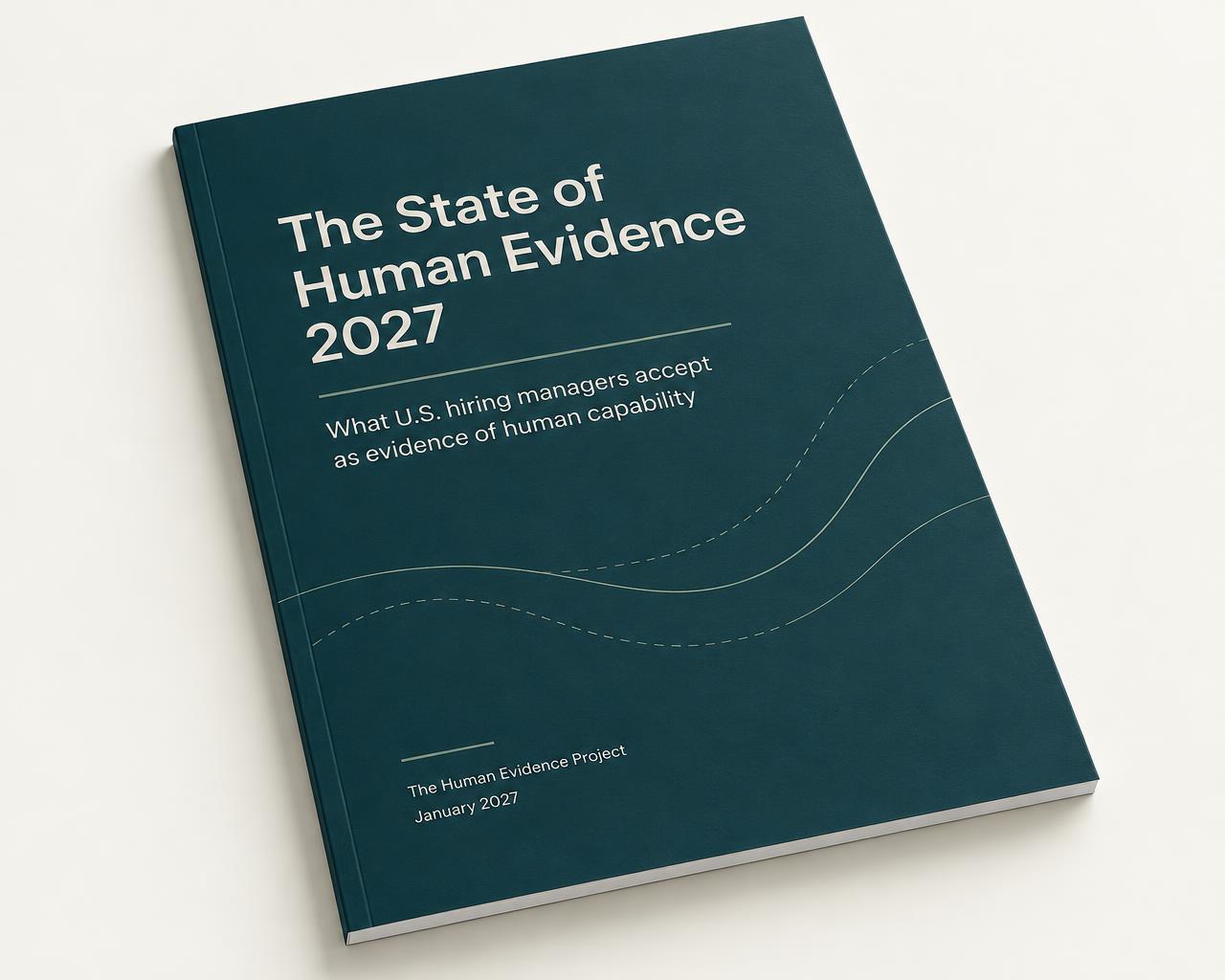
The State of Human Evidence 2027
The full report releases in early January 2027. Early findings are available now for hiring leaders; the full report, methods and dataset are available to research partners.
Explore research partnershipsJanuary 2027 · Release updates
Stay informed as the research develops
Early findings are ready now. Sign up here for the public findings summary when the full study releases in early January 2027. The full report, dataset and methodology are available to research partners.
Add your voice: open edition
The main study is closed. Until October 31, 2026, hiring managers can still take the survey. Open-edition responses are reported separately from the main study sample.
Take the open edition (about 13 minutes)