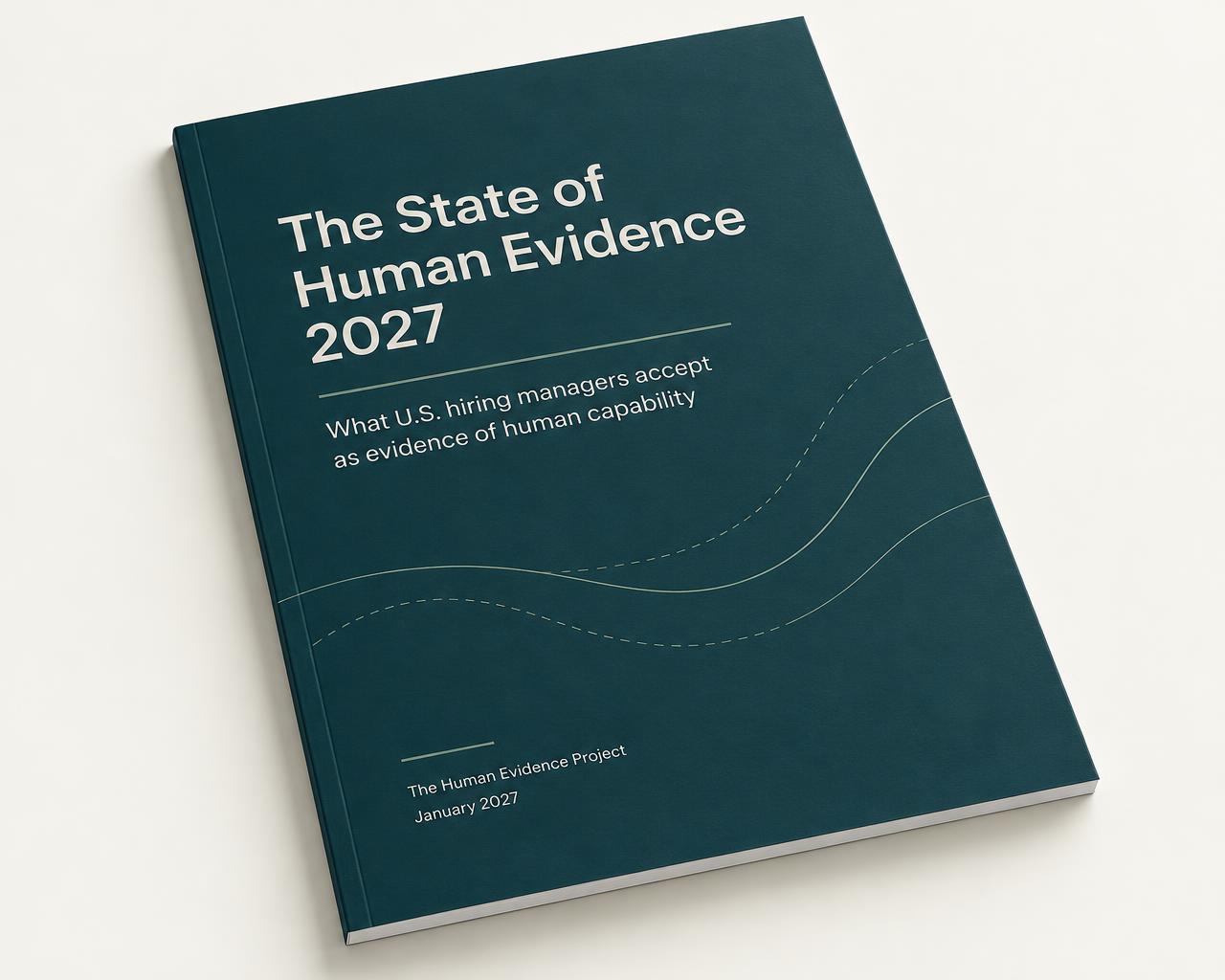
The State of Human Evidence 2027
When AI can produce the work, what proof should you trust?
We asked 148 U.S. hiring managers what evidence they trust in AI-enabled work. Explore the early findings on hiring assessments and human capability: headline results, three moves for hiring leaders, and the study’s method and limits.
Four-page briefing, open access now. Full report releases early January 2027.
A public research initiative founded and funded by SignalVerified (opens in a new tab).
Early findings · available now
41% say 1 in 4 hires or more fell short
The early findings briefing is available now for hiring leaders: headline results, three moves they point to, and the study's method, limits and sources. The full report follows in early January 2027.
- 88% were involved in a hire that turned out weaker than the evidence suggested.
- Only 12% accept the output alone as proof when AI may have helped.
- 57% want a finalist work task for most roles. Only 6% run one.
The four-page briefing is open access. Download it directly, or share your details to get the full report when it releases.
Prefer not to share your details? Download the briefing directly.
Hiring managers · available now
Built on 148 U.S. hiring managers
The briefing sets out what these managers say they trust, what they actually collect, and the gap between the two.
Talent acquisition
Survey now live
The talent acquisition survey is now open
The study now extends to talent acquisition leaders. Add your perspective: the survey takes about 10 to 12 minutes.
The central question
When a machine can produce the artifact, what is the evidence that a person contributed the capability, and who decides that it counts?
Human evidence is observable proof of how a person thinks, decides, communicates, and performs when doing real work. Our study asks what hiring and business leaders trust when AI can help produce the output, and what that means for skills-based hiring and work sample assessments.
What is human evidence?The study
How wave one was built
The first wave of an annual research initiative, built around one core question: what evidence do organizations trust when evaluating human capability in AI-enabled work? Wave one is for U.S. managers at organizations with 50 or more employees who made or influenced a hiring or promotion decision for a knowledge-work role in the past 12 months.
Fieldwork for the main study closed in October 2026. A public summary of the findings releases in early January 2027, with the full report, dataset and methodology available to research partners.
- Field
- Human capability and evidence of contribution
- Population
- U.S. managers who made or influenced a hiring or promotion decision for a knowledge-work role in the past 12 months, at organizations with 50 or more employees
- Instrument
- Structured survey with judgment tasks
- Collection
- Completed October 2026, single wave. 148 qualified U.S. hiring managers after quality review.
- Outputs
- Public findings summary; full report, dataset and methodology for research partners
Transparency
Research, then conclusions
The Human Evidence Project is a public research initiative, not an institution. It is founded and funded by SignalVerified (opens in a new tab), a company with a commercial interest in this subject. We disclose that in the open rather than in a footnote, and the principle that governs the work is simple: research first, company second.
The full research record
The survey, methodology and analysis plan are documented in full and shared with research partners, so the conclusions can be checked against the research that produced them.
The record behind each finding
Every finding is published with its stated limitations and the sample it came from. The anonymized dataset is available to research partners, so any claim we make can be checked against the record that produced it.
Findings published in full
All results are reported, including findings that challenge SignalVerified. No finding is withheld, delayed or softened for commercial reasons.
Research partnerships
Become a Founding Research Partner
Help build the evidence base for the future of human work.
As AI transforms work, organizations need better evidence of human capability, judgment, and contribution.
The Human Evidence Project is inviting up to three enterprise organizations to become Founding Research Partners of the annual State of Human Evidence study.
Together, we aim to advance rigorous, publicly accessible research that helps organizations better understand human capability in an AI-enabled world.
Research partners support the work, not the conclusions. Findings remain publicly accessible.
Research notes
The reasoning behind the study
Short pieces setting out how we think about evidence of human capability in hiring and promotion, so the reasoning behind the research can be examined alongside its findings.
Read the research notesHiring Evidence Is Failing. Leaders Already Know It.
Early findings from 148 U.S. hiring leaders explore what they trust, what they collect, and where the two come apart.
Skills-based hiring when a machine can produce the work sample
Demonstrated work was better evidence than a credential because the artifact and the ability travelled together. They no longer do.
Coming early January 2027
The full report follows
Early findings are available now for hiring leaders; the full report, methods and dataset are available to research partners.
Explore research partnershipsJanuary 2027 · Release updates
Stay informed as the research develops
Early findings are ready now. Sign up here for the public findings summary when the full study releases in early January 2027. The full report, dataset and methodology are available to research partners.